


Too Many Marketing Experts, Not Enough Strategy
Marketing advice is everywhere, but the real challenge is deciding whose advice to trust.
I spoke with my daughter’s equestrian trainer recently about her goals, her progress, and what the next steps should look like. It was a great conversation, but what really stuck with me was the clarity I felt afterward.
Before that conversation, I’d heard plenty of other opinions about her goals and how she should get there. None of that advice was necessarily wrong, but it was coming from people with different perspectives.
I'm sure this happens in plenty of other areas of life, but at that moment, it reminded me of something I see all the time in marketing.
There's no shortage of people telling you what you should be doing. The challenge is figuring out which advice actually makes sense for your goals.
Why Doesn’t Every Business Follow the Same Marketing Path?
In many traditional sports, the progression is relatively straightforward. Take soccer, for example. You move through age groups, develop your skills, compete at higher levels, and work toward championships. There’s a fairly defined path. Equestrian sports aren’t quite that simple.
There are different disciplines, divisions, competition levels, trainers, goals, and opportunities. What makes sense for one rider may not make sense for another. What looks like success to one family may look completely different to the next.
The key is having someone who understands the rider, knows their strengths and weaknesses, and can help them build a realistic path toward their goals.
Someone who sees the whole picture, not just one piece. Marketing works the same way.
There is no universal marketing strategy that works for every business. An effective marketing strategy depends on your industry, target audience, business objectives, budget, and competitive landscape.
What works for a national retailer may not work for a local service business. And what generates leads for one company may be a waste of resources for another.
Success starts with understanding where you’re trying to go.
Why Is There So Much Conflicting Marketing Advice?
If you’ve spent five minutes scrolling through LinkedIn, Instagram, or TikTok lately, you’ve probably seen some version of these:
- “This AI hack will change your business!”
- “Stop doing SEO. Do this instead.”
- “You’re using ChatGPT all wrong.”
- “Here’s the secret to getting more leads.”
- “If you’re not doing this in 2026, you’re falling behind.”
Sound familiar? With artificial intelligence changing how we search, create content, advertise, and communicate, the volume of marketing advice has become almost overwhelming.
Everyone has a strategy. Everyone has a shortcut. Everyone has the next big thing you absolutely must be doing. Some of that advice is excellent. Some of it is questionable. And some of it may work incredibly well for one business while doing absolutely nothing for another.
The problem isn’t a lack of information. It’s an overload of information with too little context.
Marketing advice often conflicts because different experts are solving different problems for different businesses. Without understanding the goals behind their recommendations, it’s difficult to know which tactics actually apply to you.
As we explored in our article on how businesses should think about SEO, AEO, and GEO in the age of AI, the terminology around modern marketing can create unnecessary confusion.
What Happens When You Follow Too Many Marketing Experts?
Imagine trying to train a horse while taking direction from five different trainers, each with a different philosophy.
One tells you to focus on technique. Another says you need more competition experience. Someone else thinks you should move up a division. Another suggests changing your entire approach.
Before long, you’re second-guessing everything. And instead of making progress, you’re spinning your wheels. Now think about your marketing.
Your social media consultant says you need to post more videos. An article tells you email marketing is making a comeback. Someone on LinkedIn insists that traditional SEO is dead. An AI influencer says you need to completely restructure your website.
So you try a little of everything. You change direction every few weeks. You chase trends. You invest time and money into tactics without knowing how they fit into your larger strategy. And then you wonder why you’re not seeing results.
The tactics aren't necessarily wrong. They just aren’t working together toward a common goal.
What Does Having One Source of Truth Mean in Marketing?
Having one source of truth in marketing means establishing a consistent, trusted framework for making marketing decisions based on your business goals, audience, performance data, and overall strategy.
It doesn’t mean relying on one person’s opinion for everything or ignoring outside expertise.
I’m not suggesting you stop learning, researching, asking questions, or exploring new ideas.
Quite the opposite.
I think it’s incredibly important to stay curious, especially in marketing, where things are changing faster than ever.
But there’s a difference between gathering information and allowing every new piece of information to change your direction.
A single source of truth means a trusted person or team who understands your business, goals, audience, resources, and long-term vision.
Someone who can look at the latest marketing trend and say:
“Yes, that’s worth exploring.”
Or, just as importantly:
“No, that’s probably not where we should spend our time right now.”
That second answer might actually be more valuable. Because a good strategy isn’t just about knowing what to do. It’s also about knowing what not to do.
Why Does AI Make a Clear Marketing Strategy More Important?
Artificial intelligence has created incredible opportunities for businesses of all sizes, but it’s also made it easier than ever to get overwhelmed.
You can ask AI a marketing question and get a detailed strategy in seconds, search for best practices and find hundreds of articles, or follow dozens of experts, each with compelling arguments for why their approach is right.
And the next day, you’ll find someone telling you the exact opposite.
AI is an incredibly useful tool, and we encourage businesses to explore how it can improve efficiency, generate ideas, and uncover new opportunities.
But AI doesn’t eliminate the need for strategy. If anything, it makes strategy more important.
From researching competitors and analyzing data to improving workflows and identifying marketing opportunities, AI offers tremendous potential. But those capabilities are most valuable when they support clear business objectives.
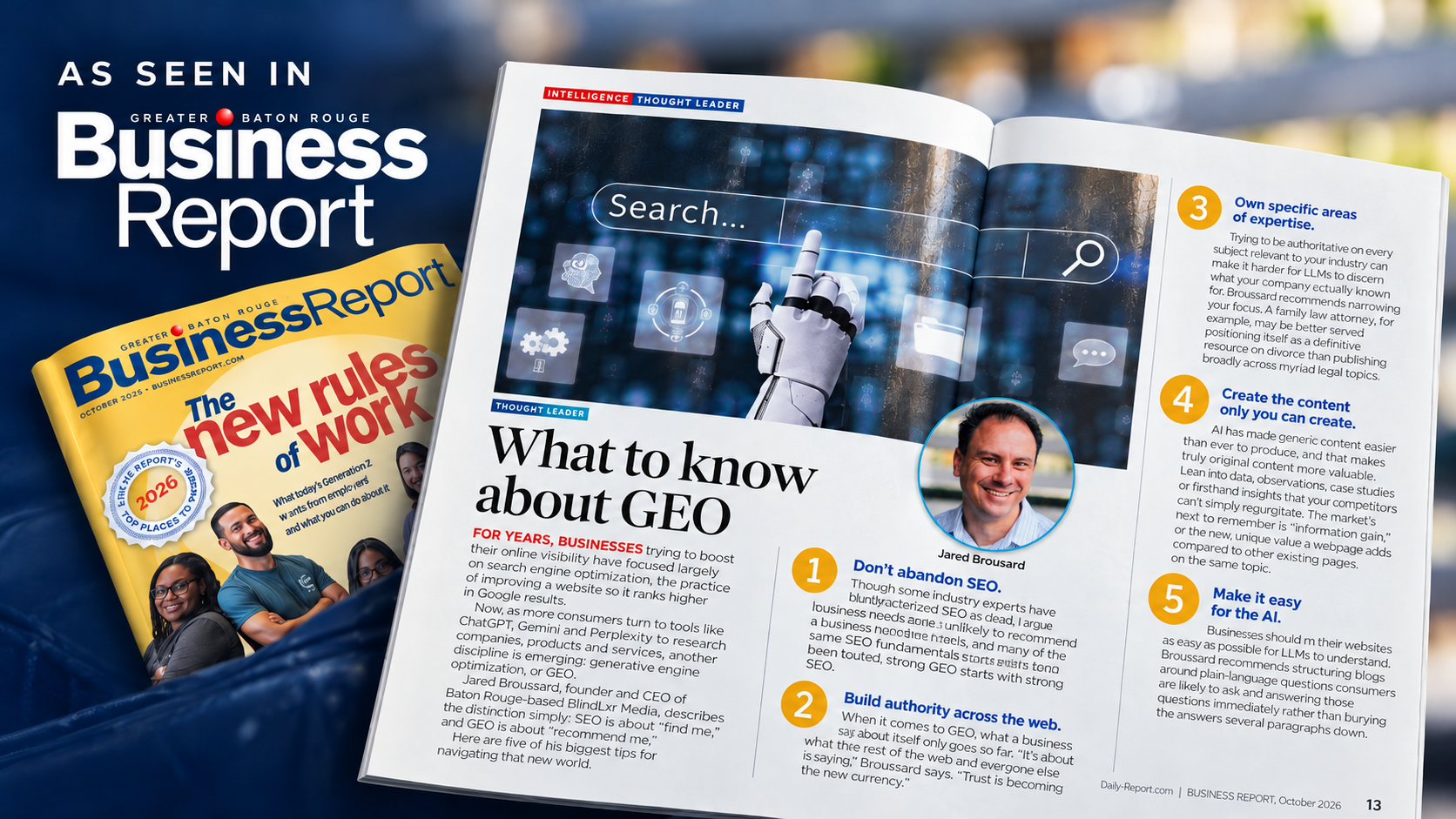
BlinkJar CEO Jared Broussard recently discussed this in The Future of Marketing in the AI Era: The Value of Better Thinking, explaining why human judgment, context, and strategic thinking are becoming even more valuable as AI evolves.
Because when everyone has access to more information, more content, and more tools, the real competitive advantage becomes knowing how to use them with purpose.
Not every new AI tool needs to become part of your marketing plan. Not every algorithm update requires a complete overhaul. And not every viral marketing tactic deserves your attention.
Your business goals should drive your marketing decisions, not the other way around.
How Do You Know Which Marketing Advice to Trust?
Before changing your marketing strategy based on the latest recommendation, ask yourself a few questions:
- Does this support our business goals? A tactic may be effective but irrelevant to what you’re trying to accomplish.
- Is this advice appropriate for our audience? What works for one industry or demographic may not work for yours.
- Do we have the resources to execute it well? Even a great idea can become a distraction if it takes time and money away from higher priorities.
- Is there credible evidence behind the recommendation? Look beyond impressive claims and consider the actual results, context, and expertise.
- How will we measure success? If you can’t connect the tactic to a meaningful business outcome, reconsider whether it deserves your attention.
These questions don’t eliminate the need to experiment. They help ensure that experimentation is intentional.
For example, businesses are hearing plenty of conflicting opinions about traditional SEO and AI-powered search. But as I explained in The Fragmentation of Search: Why Being Found Is No Longer Just About Google, the answer isn’t to chase every new platform. It’s about understanding where your customers are searching and building a strategy that supports those behaviors.
A trusted marketing partner should help you evaluate new ideas, not simply add more items to your to-do list.
Why Is Consistency So Important to Marketing Success?
Going back to my daughter’s equestrian journey, I value the advice and perspectives of people who care about her success.
But ultimately, her trainer understands where she is today, where she wants to go, and what it will take to get there. That doesn’t mean the plan will never change. Of course it will. Goals evolve. Circumstances change. New opportunities come along.
The same is true in marketing. A strong marketing strategy shouldn’t be rigid. It should evolve as your business grows, your audience changes, and new technologies emerge.
But those adjustments should be intentional, not reactions to the latest thing you saw on social media.
At BlinkJar, we believe our job isn’t simply to recommend the latest marketing tactic. It’s to understand the bigger picture and help our clients make smart decisions about where to focus their time, energy, and budget.
Our approach to search engine optimization and answer engine optimization fits into that bigger picture. These aren’t isolated tactics. They’re pieces of a connected marketing strategy designed to help businesses reach the right audience.
Sometimes that means trying something new. Sometimes it means staying the course. And sometimes it means saying, “That’s a great idea, but it’s not the right idea for you.”
Because ultimately, the goal isn’t to do more marketing. It’s to do the right marketing.
And sometimes the best thing you can do for your business is stop listening to everyone and start listening to the people who truly understand where you’re trying to go.