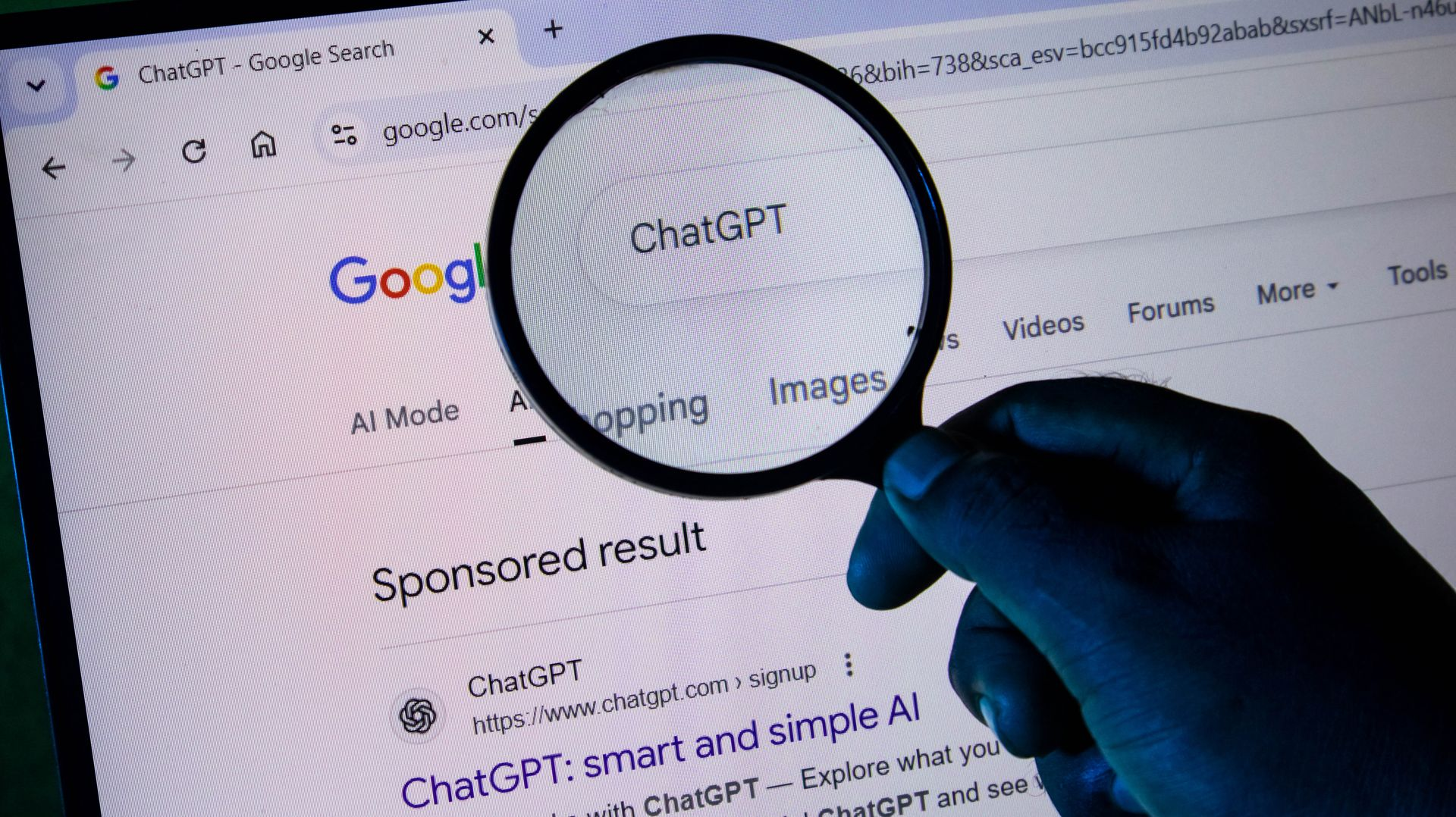



What GEO Means for Businesses: Lessons From My Baton Rouge Business Report Interview
My wife tells me I don’t talk enough. She’s probably right. But if you ever want to get me going, ask me a question about marketing in the new world of AI, and you may end up begging me to stop.
That is probably what Dillon Lowe was thinking when he reached out to me to talk about Generative Engine Optimization, or GEO. At BlinkJar Media, we have been spending a lot of time studying, testing, and talking about GEO because the way people search is changing quickly, and businesses need to understand what that means.
Baton Rouge Business Report published a publicly available overview of our conversation, “How to get AI to recommend your business,” which also links to the full feature from its October issue.
To be fair to the team at Baton Rouge Business Report, I’m not going to spoil the article's details here. Instead, I want to build on the conversation with a few real-world examples from BlinkJar and our client work. At the end of each example, I provide a helpful takeaway.
Think of this as a glimpse into what those GEO ideas look like in practice.
Does SEO Still Matter for Businesses?
SEO still matters because organic search continues to generate a significant share of measurable leads and lays the foundation for GEO.
BlinkJar reviewed 30 clients over 12 months and found that about 62% of the leads generated through their websites originated with an organic search on a search engine like Google. In simple terms, roughly 6 out of every 10 leads we tracked still started with traditional search. Not sure about you, but I would not walk away from 60% of my leads just because AI is getting all the attention.
At BlinkJar Media, our clients are understandably racing to see whether ChatGPT, Gemini, Perplexity, or whatever their favorite large language model is recommending for their business. I get it. The curiosity is hard to resist.
AI is the shiny new Tesla with all the bells and whistles. Traditional Google search is more like the F-150. It may not get all the attention, but it still does a lot of the heavy lifting.
Takeaway #1: AI search is growing, but Google is still generating business. GEO should build on SEO, not replace it.
How Does AI Decide Which Businesses Are Credible?
AI systems can look beyond your website for signals that reinforce whether your business is credible and known for what it claims to do.
There is an old saying: Your reputation is what people say about you when you are not in the room. In GEO, your authority is what the rest of the web says about you when you are not on your own website. We have been testing this ourselves at BlinkJar. Over 90 days, I published simple Walk & Talk videos on LinkedIn about once every other week. During that period, my impressions increased 778%, with 32% coming from outside my existing network.
The goal was never to go viral. The goal was to keep showing up, share something useful, and reinforce the connection between Jared Broussard, BlinkJar Media, and marketing expertise.
Your website can tell people what you know. LinkedIn, YouTube, podcasts, reviews, media coverage, and other credible sources can help back it up.
Takeaway #2: Your authority is stronger when the rest of the web tells the same story you do.
Authority is not built in one place. The more consistently your expertise is reinforced across the web, the easier it is for people and AI systems to understand what your business should be known for.

What Should My Business Write About to Get Recommended by AI?
If your goal is to create content that helps your business get recommended by AI, your business should focus on a smaller set of topics where it has real experience and wants to build the strongest authority, rather than trying to cover everything.
One of my favorite marketing quotes comes from my advertising days at WAFB in Baton Rouge. Peter Drucker said, “Concentration is the key to all economic success.” That quote stuck with me because I learned the same lesson in local television sales. If a local car dealer’s sales were 92% trucks and 8% cars, we did not treat them like a car dealer. They were a truck dealer. That was clearly where the strength was, so we leaned into it.
The lesson was simple: promote your strengths and starve your weaknesses in marketing and advertising.
That principle applies surprisingly well to GEO. One of our professional lab services clients offers several services across the laboratory lifecycle. Instead of marketing all of them equally, the company chose to focus heavily on laboratory relocations. Over three years, qualified lab relocation leads increased by more than 300%. The company did not stop offering its other services. It simply became clearer about what it wanted to be known for.
In content marketing, sometimes narrowing the message actually expands the opportunity.
Takeaway #3: You do not need to be known for everything. You need to be known for the right things.
What Kind of Content Is Most Likely to Get Cited by AI?
AI is more likely to cite content that adds original information, firsthand experience, and useful insight that cannot be easily duplicated elsewhere. People, and large language models, prefer a point of view grounded in real experience over content that repeats what everyone else has already said.
Anyone can copy and paste an article about a topic or service they have never actually worked with. Very few can share the firsthand lessons, observations, and perspective that come from doing the work. That is where real expertise becomes hard to duplicate.
AI can create generic content quickly. It cannot recreate your experience. That is also why E-E-A-T matters. Experience, expertise, authoritativeness, and trust all help reinforce whether content is credible and worth using.
One of our environmental consulting and engineering clients had firsthand experience with a Louisiana school project involving mold and moisture after a flood. Through client interviews, we captured that experience and turned it into a case study explaining what happened, what was discovered, and what others could learn from the project.
That created something a generic article could not: real knowledge from people who lived the experience. This is the idea behind information gain. It means adding something genuinely new or useful, like original data, firsthand experience, or insight not already available online.
Takeaway #4: The content most worth citing is the content only you could have created.
E-E-A-T gives GEO something AI can’t manufacture on its own: real experience, real expertise and real reasons to trust the source.

How Should I Structure My Content So AI Can Understand It?
Structure your content so AI can understand it by leading with clear questions, direct answers, and logically organized supporting information. At BlinkJar, we increasingly use the BLUF method: Bottom Line Up Front.
The idea is simple. Put the main answer where people can see it immediately, then provide the supporting detail.
Here is an example of the BLUF method put to use by BlinkJar Media:
Does GEO replace SEO?
GEO does not replace SEO. It builds on many of the same fundamentals of search, content, and authority.
Do not make readers or machines work through several paragraphs to find the point.
Takeaway #5: Answer first, explain second.
What Does This Mean for Your GEO Strategy?
When Baton Rouge Business Report reached out to me to talk about GEO, I was excited to share what we have been seeing because this topic seems to change daily.
I probably gave them way more than they ever needed or wanted for one article. That is also part of what makes GEO so interesting. There is a lot to unpack, and we are all still learning as the technology, search behavior, and best practices continue to evolve.
Technology is changing at a remarkable pace. Ironically, the same qualities that helped businesses earn trust 50 years ago still matter today. The businesses most likely to join the conversation about large language models are those that consistently build trust, demonstrate real expertise, and communicate what they know clearly.
That is what makes GEO so fascinating to me. The technology may be new, but the fundamentals of credibility are not.
Want the original Business Report perspective? Read “How to get AI to recommend your business” for the publicly available overview and access to the full feature, which may require a Business Report subscription.