

SEO, AEO and GEO: Why Baton Rouge Businesses Need All Three
Just last week, I was on one of our weekly client calls, and they asked whether they should move away from SEO to focus on AI visibility and AEO. This question inspired me to write this blog.
Search is changing, but that does not mean SEO is being replaced.
Instead, businesses now need to think about three connected layers of digital visibility: SEO, AEO, and GEO. Each serves a different purpose, but they work together. Strong visibility in AI-generated answers and recommendations still begins with the same foundation that helps a business perform well in traditional search.
The simplest way to think about it is:
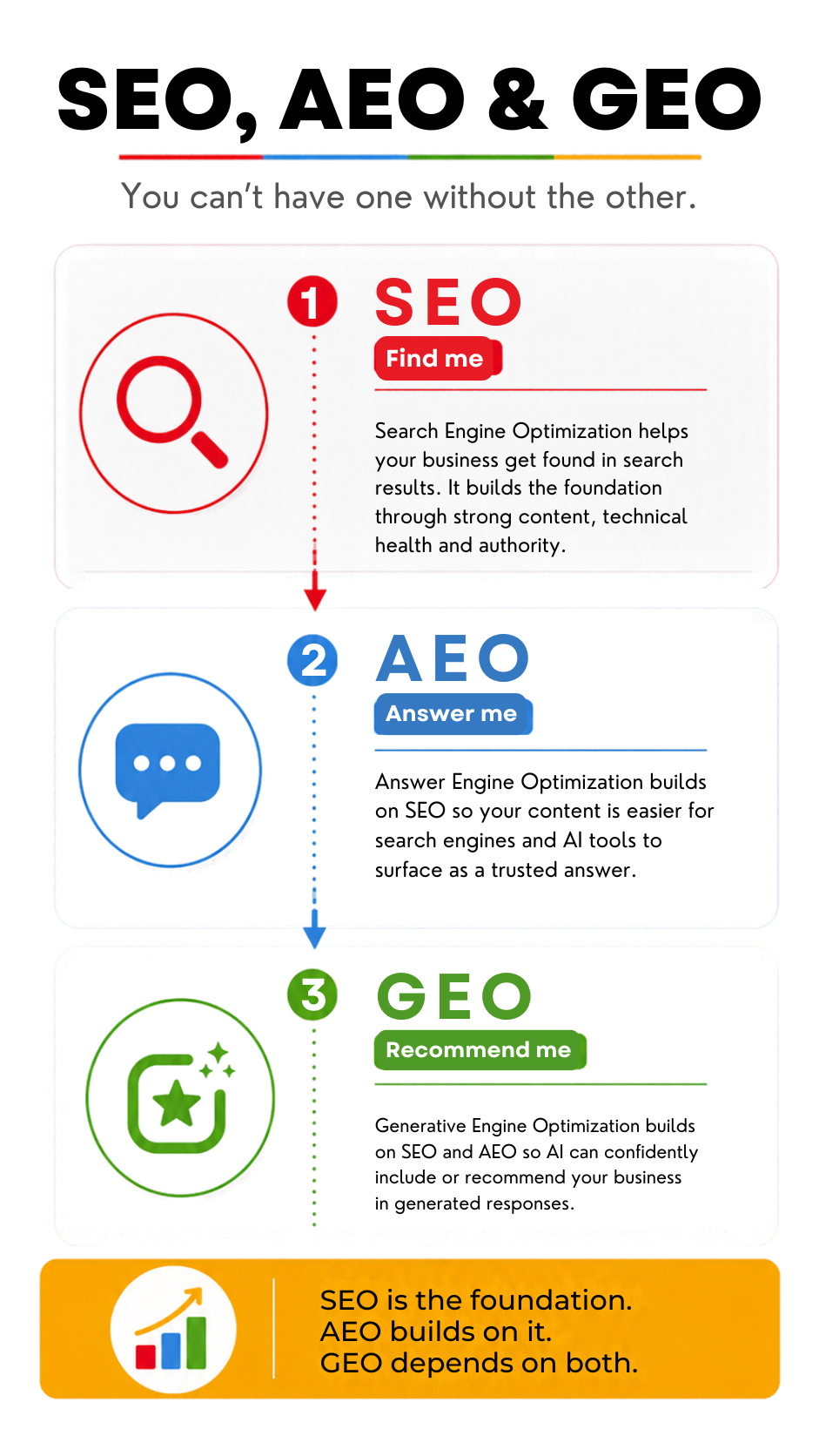
SEO helps people find you.
AEO helps search engines and AI answer with you.
GEO helps AI confidently recommend you.
And you really cannot have one without the others.
What Is SEO?
Search Engine Optimization, or SEO, helps your business get found in traditional search results.
SEO focuses on creating useful content, maintaining a technically sound website, and building enough authority for search engines to understand what your business does and when it should appear. The client I referenced earlier dominates search results because we have built their authority through content and SEO efforts over the last 12 years.
That foundation still matters, even as more people use AI tools to research businesses, products, and services.
What Is AEO?
Answer Engine Optimization, or AEO, helps your content become a trusted source for answers.
Instead of focusing only on where a webpage ranks, AEO considers whether search engines and AI platforms can clearly understand and extract the information on your website.
This means answering real customer questions directly, organizing information clearly, and demonstrating expertise and credibility.
What Is GEO?
Generative Engine Optimization, or GEO, helps increase the likelihood that AI platforms include or recommend your business in generated responses.
GEO builds on both SEO and AEO. AI systems need enough reliable information about your business to feel confident mentioning, citing, or recommending it.
That confidence may come from your website, but it can also be reinforced through reviews, industry directories, media coverage, case studies, professional credentials, and other trustworthy third-party sources.
You cannot get ranked, become the answer, or earn the recommendation without first building trust. SEO creates the foundation, AEO makes your expertise easier to understand, and GEO gives AI the confidence to include you.

Does GEO Replace SEO?
No. GEO does not replace SEO, and AEO does not make SEO obsolete.
They are layers of the same visibility strategy.
Think of it this way:
SEO → Find me
AEO → Answer me
GEO → Recommend me
A business with weak content, unclear expertise, or little authority across the web will have a harder time succeeding in any of the three.
What Do SEO, AEO, and GEO Look Like in Practice?
The best results happen when SEO, AEO, and GEO are treated as one connected strategy instead of three separate tactics.
We saw a great example of this recently during a meeting with Lucas Firmin Pools, a longtime BlinkJar client.
They have been working with us on SEO for about 10 years, and that long-term foundation matters. Today, they are showing up across traditional search, answer-driven results, and AI-generated recommendations. During our meeting, we showed them how all three layers connect and why the work they have done over time is helping them perform well in each one.
But the work does not stop once a business is visible.
We also reminded their team to pay attention to the questions customers and potential customers are asking. If they hear a question that Lucas Firmin Pools does not appear for in search or AI results, we want to know about it.
That allows us to identify the gap, create or improve the right content, and make it easier for search engines and AI platforms to understand that Lucas Firmin Pools is a relevant source for that topic.
That ongoing feedback loop is becoming an important part of modern search strategy.
How Can Baton Rouge Businesses Improve SEO, AEO and GEO at the Same Time?
Businesses can improve all three by strengthening the same core signals: useful content, clear expertise, accurate business information, and trusted third-party validation.
Start by creating content that answers the questions your customers actually ask. Make sure your website clearly explains who you are, what you do, and why you are qualified to do it. Support those claims with case studies, reviews, credentials, media mentions, and other reliable sources across the web.
For businesses, that also means making your local relevance clear through accurate location information, locally focused content, and consistent business details across trusted directories and platforms.
And do not rely only on keyword research to tell you what people want to know. Your sales team, customer service team, and existing customers can be some of your best sources of content ideas. When someone asks a question your business should be visible for, treat that as useful search intelligence.
The goal is not to chase three separate strategies.
SEO is the foundation. AEO builds on it. GEO depends on both.
That is how Baton Rouge businesses can position themselves to be found in search today and included in the AI-driven customer journey that is developing around it.