

Ads on ChatGPT Are Live: What AI Advertising Means for Your Businesses
Hey everyone. It's Jared. I want to talk about digital advertising, which is one of my favorite topics.
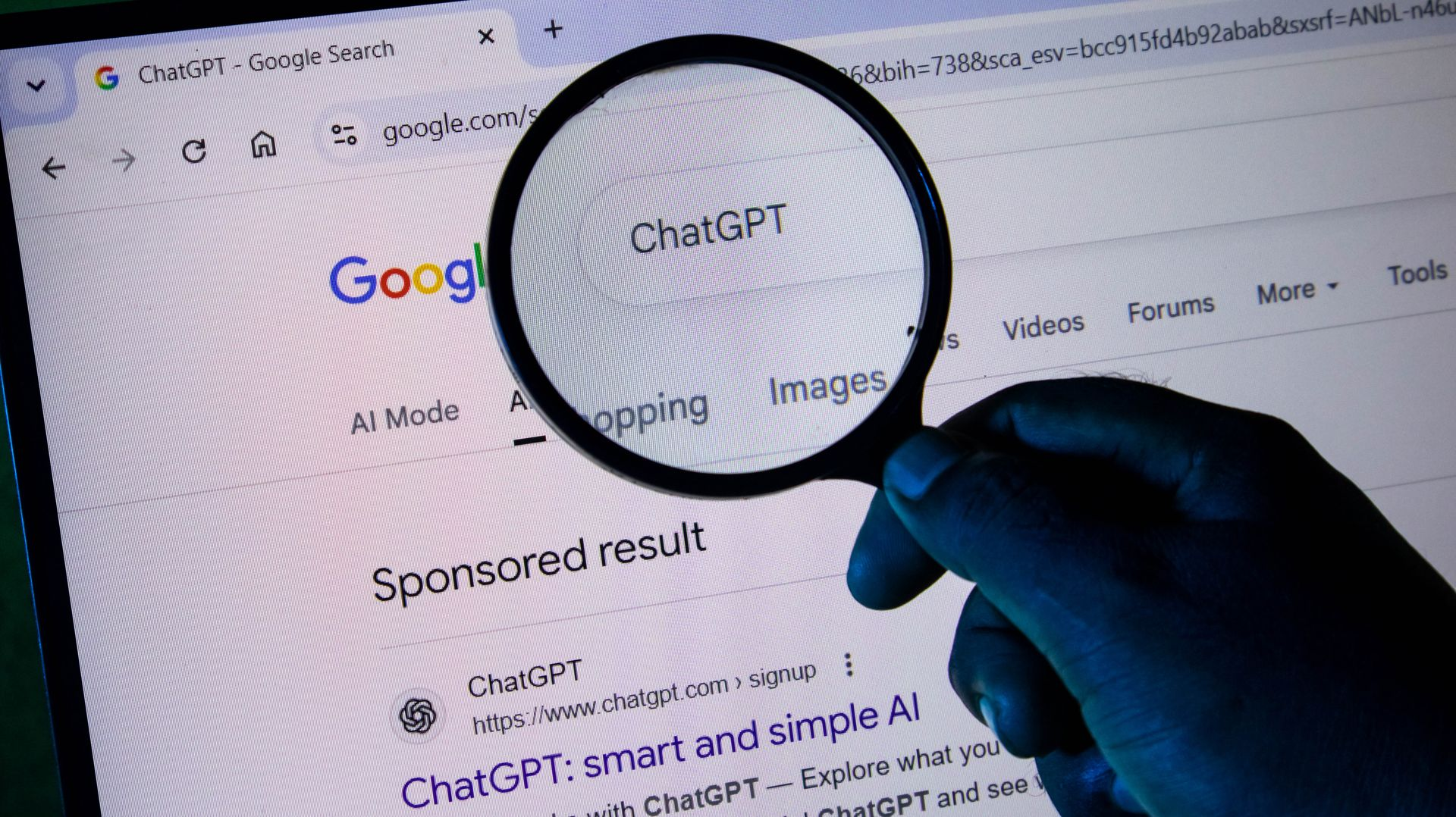
Advertising inside ChatGPT is no longer theoretical. It has begun. Confirmed reports show ads now appearing for some signed-in desktop users in the United States. Even more surprising, they are triggering on the very first prompt.
That detail alone changes the conversation. For the first time, brands are appearing directly inside AI-generated answers at the exact moment someone asks a question, compares options, or evaluates a decision. That is fundamentally different from search engines or social feeds.
And it signals a meaningful shift in how digital advertising will work moving forward.
ChatGPT Ads Are Now Live in the U.S.
Research from AI ad intelligence firm Adthena has identified the first confirmed ChatGPT ads for signed-in U.S. desktop users. The initial assumption was that ads would appear only after extended back-and-forth conversations.
That is not what is happening.
In one documented case, a user asked:
“What’s the best way to book a weekend away?”
A sponsored placement appeared immediately in the very first response.
That tells us OpenAI is treating single, high-intent prompts as viable advertising inventory. This is not about long conversational sessions. It is about decision moments.
What Do Chat GPT Ads Look Like?
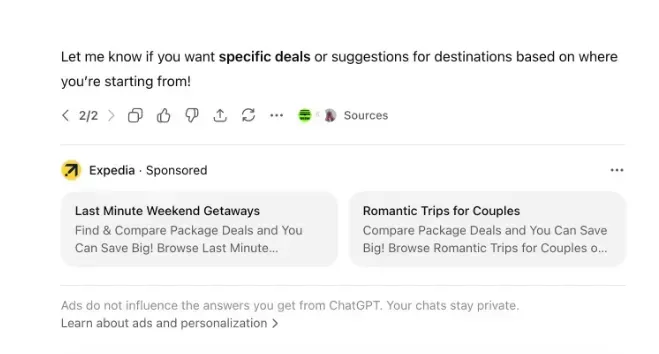
The ads currently:
- Appear at the bottom of responses
- Include a brand favicon
- Carry a clear “Sponsored” label
- Are integrated into the answer environment
This confirms that OpenAI has quietly entered ChatGPT's monetization phase.
Recent example of ad appearing in Chat GPT:
Why Advertising in ChatGPT was Always Inevitable
I always smile a little when founders say their platform will never run ads. Not because I doubt their intentions. But because history is consistent. There has never been a major media platform that has scaled globally and sustained itself long-term without advertising. Not newspapers. Not radio. Not television. Not search engines. Not social media.
Every major communication channel eventually integrates advertising because scale requires revenue. So when leaders suggested ChatGPT would remain ad-free, I understood the aspiration. But I also factored in the economics.
OpenAI is building one of the most infrastructure-heavy platforms ever created. AI models are expensive to train and operate. Advertising was always the logical monetization path.
Initially, access appears limited to large-budget advertisers. That is standard in early ad ecosystems where inventory is limited and testing is controlled. If ad performance proves strong, broader access and self-serve tools will follow.
That is how media evolves.
ChatGPT Ads Emerge as a Third Major Digital Advertising Channel
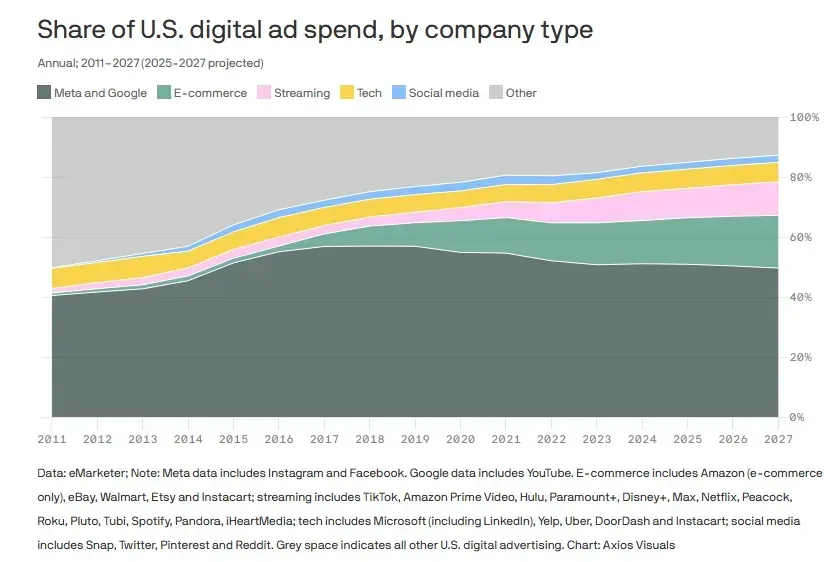
For years, businesses had little choice but to advertise on Google and Meta. Those two platforms dominated digital ad spend.
ChatGPT introduces a legitimate third channel. Having another option matters because it creates competitive pressure. It gives brands another high-intent environment. And it shifts advertising into a space where users are actively thinking and deciding.
Graph Source: Axiom
ChatGPT Ads Will Succeed or Fail Based on Relevance
The psychological shift here is critical. People do not open ChatGPT to scroll.
They open it to:
- Solve a specific problem
- Refine a shortlist
- Plan a purchase
- Write something
- Make sense of a complex decision
This is task-driven behavior, not passive discovery.
When users are in task mode:
- Attention narrows
- Interruptions feel more intrusive
- Speed and clarity matter
- Distractions are filtered out
That creates a very high ceiling and a very low floor for advertisers. If an ad directly supports the task at hand, it can be incredibly effective. When it fits naturally into the conversation and provides a solution, a shortcut, or a helpful next step, it does not feel like advertising. It feels like assistance. In that scenario, engagement can be strong because the ad becomes part of the process.
But the opposite is also true.
If brands try to inject non-relevant, interruptive, feed-style ads into this environment, performance will suffer quickly. ChatGPT is not built for awareness blasts or distraction marketing. Users will reject anything that slows them down or adds friction.
Ads in ChatGPT will reward relevance and punish interruption. Trust in AI environments is still forming. If advertising feels manipulative, off-topic, or self-serving, it will damage both performance and perception.
The brands that win in ChatGPT will be the ones that understand this difference. Not just what to advertise, but when and why it makes sense inside the user’s moment of need.
How Should Businesses Prepare for ChatGPT Ads?
ChatGPT’s ad era has begun, and it is moving faster than many expected. Ads are appearing on first prompts and inside high-intent decision moments.
So how should businesses prepare?
Start by recognizing that this is not just another ad placement. It is a behavioral shift.
Businesses that succeed with ChatGPT ads will:
- Understand why people use ChatGPT and what tasks they are trying to complete
- Align messaging to support those tasks rather than interrupt them
- Invest in helpful, educational content that builds authority and trust
- Focus on clarity and real solutions instead of generic promotional messaging
This environment rewards usefulness. It penalizes noise. AI-driven discovery is not about shouting louder. It is about being relevant at the exact moment someone needs help.
The brands that prepare now, by building trust and creating practical value, will have the advantage as ChatGPT advertising expands.